Hondarribia
Ofrenda a la tormentaHondarribia is a coastal town at the mouth of the Bidasoa and the southernmost setting in a widening investigation into suspicious infant deaths. Its importance is both geographical and practical: deaths recorded along the river carry the inquiry across the boundary into Guipúzcoa, where Amaia Salazar’s team cannot investigate on its own authority. The town also brings the river pattern into the cemetery, where disputed burials and the prospect of opening graves turn a map-based hypothesis into a search for physical evidence.
Coastal Setting and the River Pattern
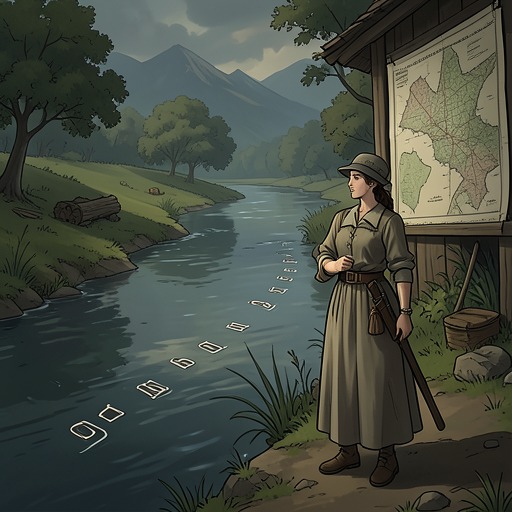
The investigation first treats locations as a problem to be mapped rather than as isolated incidents. Amaia plots the homes of infants whose deaths have already been investigated, then notices that their places form a line along the Baztán River. The river changes its name downstream, becoming the Bidasoa; the apparent change in name marks a change of province, not a break in the watercourse. Hondarribia, on the coast, therefore belongs to the same geographical corridor as the inland communities, even though it lies beyond the team’s ordinary jurisdiction.
That corridor extends from the upper river settlements through Elizondo, Elbete, and Oieregi, and onward toward the coast. A later map adds cases in Elizondo, Oronoz-Mugaire, Narbarte, Doneztebe, and Hondarribia, making the sequence of locations along the river difficult to dismiss as a cluster confined to one town. Amaia asks investigators to distinguish the newer cases from older ones on the map; together, the marks produce a grim line following the water from its source toward its outlet. The map does not establish a cause, but it gives the team a concrete pattern to test against family histories, medical records, and the circumstances of burial.
Infant Deaths and Investigative Limits
Investigators identify four infant deaths in Hondarribia on the banks of the Bidasoa. In all four, the official cause is sudden infant death syndrome, and autopsies were performed at the forensic institute in San Sebastián. The families initially appear unlike many of those already under examination: they include business owners, bankers, and doctors, and are described as financially comfortable. That difference complicates the developing profile rather than erasing the geographical connection.
The team cannot simply proceed as it has in Navarre. Hondarribia lies in Guipúzcoa, outside its jurisdiction, so investigators would need a request through a judge in Irún to obtain formal authority there. Amaia therefore tells the team to assemble the family information before deciding whether to seek that route. She also asks them to exclude baptized girls, since the pattern under investigation concerns particular deaths and the baptism information is not recorded on death certificates. Establishing it requires contacting parishes one by one and speaking with priests, whose access to the records and limited office hours make the work slow. In Hondarribia, that process reduces the four cases to two: one child was a German girl who died while her parents were on holiday, and another had been baptized.
The surviving leads are not interchangeable. One divorced mother is convinced that her daughter is not in the coffin, recalling something strange at the funeral, but the family tomb belongs to her former husband’s family and she has no power to authorize an opening. Another divorced mother agrees to an inspection of the tomb in which her daughter was buried. Her former husband is a client of Lejarreta y Andía, and the parents had argued bitterly over where the child should be buried; the girl was ultimately placed in a tomb owned by the mother’s family. The mother’s father is a justice of the peace in Irún, a connection that may help the investigators obtain a court order. These different circumstances determine which suspicion can be checked and how.
The Cemetery and Its Tombs
Amaia visits the Hondarribia cemetery with Fermín Montes and Zabalza before a planned opening. The family Lujambio’s tomb is a simple, ground-level structure faced with gray marble; photographs set into its slab show the people buried there, many images apparently dating from the 1960s. Nearby is the López family tomb, which its owners refuse to open. These graves make visible the practical and personal barriers behind the investigation: proximity in the cemetery does not mean equal access to the dead.
The team also examines a strikingly separate tomb marked Tabese. Four granite posts support a heavy chain around it, and its angled position breaks the alignment of the other graves. A discoidal stele bears an anthropomorphic line; beneath it, a plaque covers the tomb’s original name with the single word Tabese. Large white flowers blanket most of the raised slab, concealing any other inscriptions. Behind the tomb, in a work area, Amaia sees folded blue tarpaulins, a thick rope gathered into a conspicuous knot, a rusty wheelbarrow, an open drain, and a gridded table with damp traces. The table is used to remove remaining soft tissue from bones taken from niches before the bones are transferred to a common ossuary. The setting is not merely picturesque: its working equipment gives the cemetery an ordinary, material side alongside its concealed graves and unanswered questions.
A Place Where the Pattern Reaches the Coast
Hondarribia gives the river map a consequential edge. The suspected sequence is no longer only an inland pattern in Navarre; the four initial cases place it on the Bidasoa in Guipúzcoa, where jurisdictional boundaries slow the inquiry just as the geography invites it to continue. The coastal cases also complicate the emerging profile: the families’ relative prosperity differs from the financial hardship found among many earlier families, while the shared river location remains.
The river’s reach becomes tangible after a storm. Amaia drives between Hondarribia and Elizondo past fallen branches and stripped leaves, then considers the Baztán’s swollen flow after heavy rain at its headwaters. The water has torn at its banks on its way to the mouth at Hondarribia. Seen afterward, the river is quiet again, but its course connects the upper valley, the mapped deaths, and the coast. Hondarribia thus stands at once as a real boundary in the investigation and as the downstream limit of a pattern that the team must decide whether it can follow across that boundary.